
Notifications 9
Progress review gives us direction and new perspectives
The vehicle of Specialized Investment Funds (SIFs), launched in the space between Mutual Funds (meant for retail investors) and Portfolio Management Services (PMS) or Alternative Investment Funds (AIFs) meant for HNIs, has multiple advantages for investors.
Being within the fold of Mutual Funds, it has the taxation advantage of MFs. MFs per se are tax-free trusts, hence profits booked accrue as such to the fund. PMS and AIF categories I and II are pass-through for taxation purposes;
SEBI allows short position in SIFs upto 25 percent of the portfolio. MFs are long-only funds, which means when the fund manager has a view on a stock price moving up, and it actually moves up, the fund benefits. If the fund manager has a view on a stock price moving down, s/he cannot benefit by going short, in a MF. It is possible in SIFs.
Like MFs, SIFs can use derivatives for hedging i.e. taking short positions on stocks in the portfolio. This reduces volatility in the fund when the market is volatile
The first SIF was launched in October 2025. As per AMFI data, as on October 2025, there were four investment strategies (funds), more than 10,000 investor folios, and more than Rs 2,000 crore of AUM. This indicates ticket size of approx. Rs 20 lakh per folio, against the regulatory minimum of Rs 10 lakh. As on March 2026, there are fourteen investment strategies (funds), more than 44,000 folios, and more than Rs 10,000 crore of AUM. The average ticket size per folio has moved up to approx. Rs 24 lakh per folio.
As per industry data, there are seventeen investment strategies (funds), plus three in NFO i.e. total twenty funds across twelve AMCs. These funds are across strategies allowed by SEBI, which are equity long-short, hybrid long-short, equity ex-top-100 long-short, active asset allocator and sector rotation. Reportedly, there are more AMCs and NFOs in the pipeline. However, SEBI has also allowed debt long-short and sectoral debt long-short strategies; we are yet to see fund launches in debt categories.
The funds launched so far, are mostly conservative in nature. This conservatism is partially due to the derivative short positions allowed by regulations. While short positions upto 25 percent of portfolio is allowed, it has been used by fund managers only to a limited extent, much less than 25 percent. This is due to market movement or reading of market movement by fund managers. The major reason for calling the approach conservative, is the use of derivatives for hedging. When the fund manager takes a short position in a stock which is there in the portfolio, is reduces volatility when the market is volatile.
Net-net, the SIFs available are mostly a variant of certain MF categories. In MFs, there is a category called Balanced Advantage Fund (BAF), where there is an exposure to equity, usually more than 65 percent to make it eligible for equity taxation, and the balance is in debt. Part of the equity exposure is hedged, to make BAF funds defensive against equity market volatility. There is another MF category called Equity Savings Fund (ESF), where there is a defined range of usual (unhedged) equity, hedged equity and debt. Most of the SIFs on offer are comparable to, or a variant of, BAFs or ESFs. There are relatively aggressive strategies as well, like equity ex-top-100 funds.
In the initial stage of an industry e.g. SIFs being seven months old, it is good to be conservative in approach – the baby steps so to say. However, going forward, there should be more funds on offer, on the risk-return spectrum. This is about the availability basket for investors across the risk-return scale.
The initial purpose of the regulator was to make an investment vehicle available in the space between MFs and PMS. The rationale was, certain market participants e.g. stock brokers offer the service of investing money for clients, by investing in stocks, for an amount much lower than Rs 50 lakh. In a way this is a portfolio management service, without obtaining PMS license from SEBI. The ticket size of Rs 10 lakhs sits in that space. Arguably, certain high-risk categories may be allowed in SIFs.
The limit on stock exposure is 10 percent in MFs and SIFs, whereas there is no limit in PMS. The stock limit may be enhanced by allowing new high-risk categories in SIFs. Moreover, SIFs cannot take leveraged position using derivatives, which only category 3 AIFs can. Leverage to a certain extent, say 125 percent of corpus, may be allowed, in a new high-risk SIF category. This would be targeted to those investors who drift to PMS for the high-risk differentiated strategies.
Author: Joydeep Sen, a corporate trainer (financial markets) and Finance author
This article was originally published in Mint as SIFs at seven months: baby steps now, broader risk canvas ahead
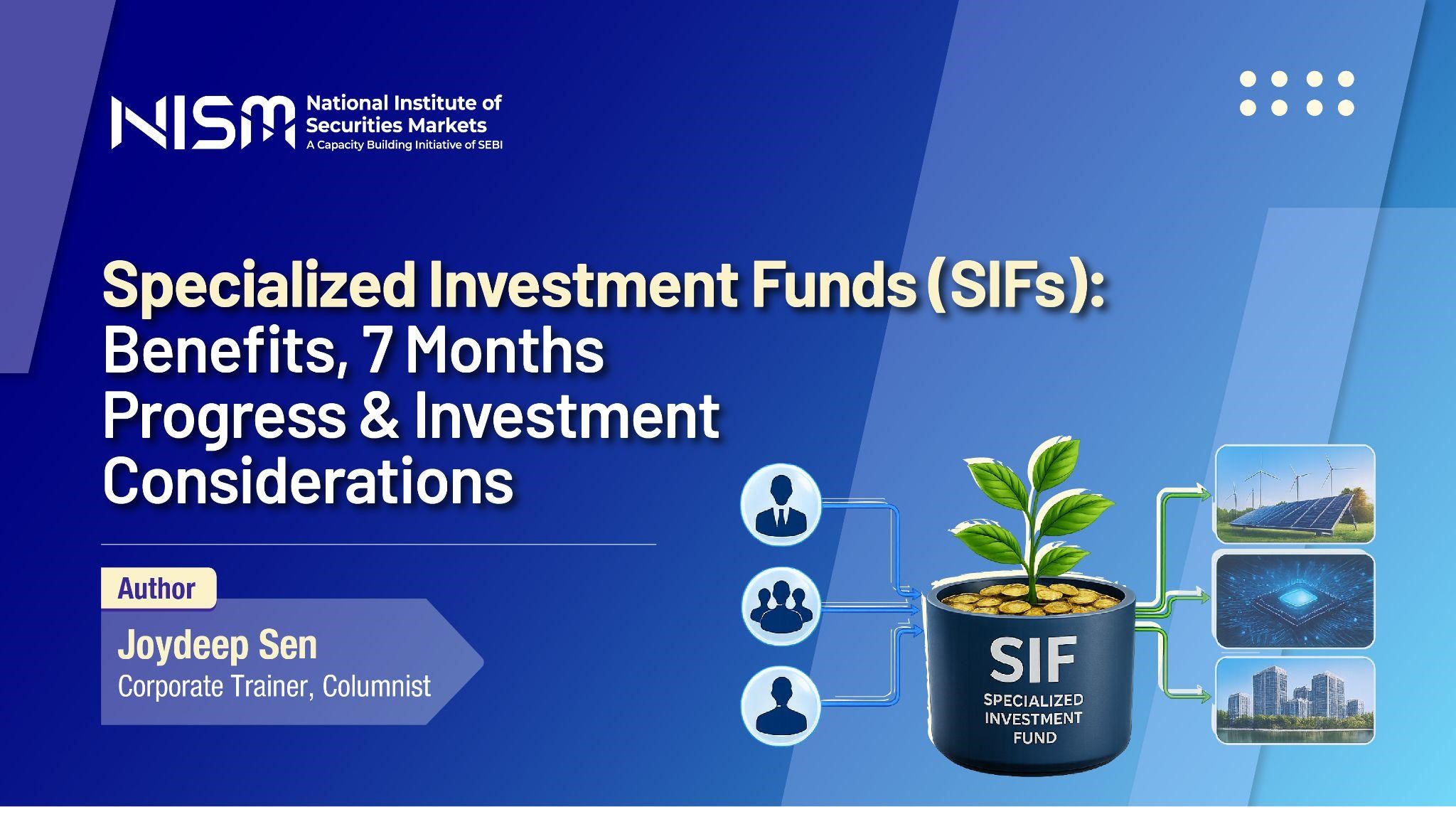
Last Updated on: May 27, 2026What is SIF? Benefits, 7 Months Progress & Investment Considerations Progress review gives us direction…

Last Updated on: May 29, 2026 The “Melody” Incident: A Case of various Behavioural Bias in Indian Markets Modern finance…

Last Updated on: May 21, 2026 How to Make an Investment Portfolio for Long-Term Wealth Creation In the world of…
© 2026 National Institute of Securities Markets (NISM). All rights reserved.
